The Fuck Sign as the Center of Possibility
While the previous article served as a comprehensive summary of information,
new perspectives emerged during my study of contemporary thought and representation,
prompting this revised acknowledgment.
Contents
Literary Arts>
The Fuck Sign as the Center of Possibility>
Complete Critical Analysis by Element>
Literary Arts>
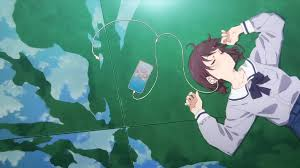
As symbolized by the altered ending of the final episode’s opening sequence, one of music’s essential roles—building connections with the world and others—dissolves the conflict between Nina and Hina.
Though Nina and Hina severed ties in high school, one thing that once connected them was music,
Diamond Dust’s “Empty Box,”
which becomes the nexus linking them (not in the classroom, but on the rooftop).
Setting out from Diamond Dust,
one pursued the extraordinary sung by Momoka, persevering in the extraordinary (Nina),
while the other persevered in the everyday of Diamond Dust to protect the ordinary (Hina).
The means (music) one employs to believe in value (innovation)
is, conversely, swallowed by that very value due to the sublimated value inherent in the means (innovation and stability).
The extraordinary (innovation) perpetually succumbs to the ordinary (stability).
This is a history repeated over the past 120 years,
much like how the blues—born from the liberation of Black slaves as a slave culture and serving as the role of autobiographical fiction—lost its countercultural essence by becoming R&B, then rock, and finally mainstream, embraced by the masses.
Rebellion will be defeated. Order will be restored. Yet rebellion endures.
Order will one day crumble again through rebellion.
Perpetual defeat itself is victory. After a hundred generations attempt to live out three days of truth,
someday—yes, someday—children with strong eyes will be born.
And they will gaze upon the sun without ever tiring,
walking into a world of eternal light unknown to us.”
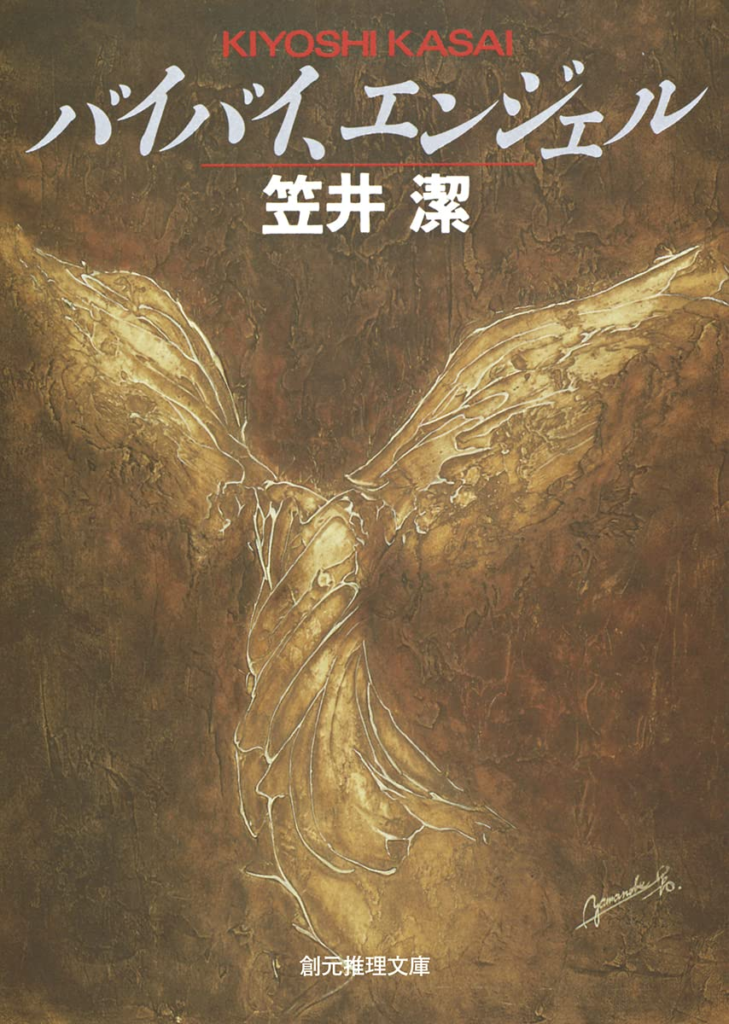
This is a passage from “Bye Bye, Angel,” a philosophical inquiry borrowing the genre name of detective fiction, conceived by Kiyoshi Kasai from the struggles and defeats of the All-Campus Council generation.
In the scene where the story’s criminal explains their motive, the criminal accuses the masses.
They claim the masses lose revolutions because they collude with power.
But the detective refutes this. He demands they confront human potential, the true moments buried in history.
In Girls Band Cry, Nina and the others’ defeat was inevitable.
Rock as counterculture is destined for perpetual defeat.
Subculture (counterculture = minority) exists
as rebellion against the dominant culture (traditional culture = majority),
against the masses = power.
However, the moment a subculture gains mass appeal (majority status),
it becomes the power = majority, spawning a new counterculture.
This structure of perpetual reproduction of binary opposition
is likely the mechanism determining the eternal defeat of counterculture,
and of rock (and its offshoots like punk, metal, melodic hardcore, etc.).
Here, I wish to consider the “center of possibility” in “Girls Band Cry.”
The “center of possibility” refers to what Tsunehiro Uno identifies as the role of criticism:
examining, through understanding a work, the applicability to the real world of the possibilities
for the things and ideas presented within that work.
What is the “center of possibility” in Girls Band Cry?
It is likely “deconstruction” and “a new fuck sign.”
Music is an individual’s prayer to the gods and a celebration; it exists as a cultural activity where the “individual” remains an “individual.”
Rock, in particular, considering its aforementioned origins, finds its raison d’être as a rebellion against existing values.
It is a new value created by emerging culture as rebellion against existing values—essentially, the creation of a “binary opposition” between dominant and subaltern cultures.
Furthermore, punk rock, stemming from the aforementioned impossibility of overturning rock’s values,
likely possesses a strong existential perspective aimed at devaluing that binary opposition itself.
For example, writer Yota Tokuda,
in his analysis of Girls Band Cry, states the following:
(Quote)
“Punk rock, which once functioned as counterculture, expressed chaos as a physical performance through such actions, seeking to destroy the very oppositional structures themselves—‘domination/subjugation,’ ‘majority/minority,’ ‘masculinity/femininity.’ The true punk spirit lies not in mere ‘minority rebellion,’ but in the relentless will to deconstruct the very conditions that establish the binary oppositions defining ‘majority/minority’.” (End quote)
Mr. Tokuda’s analysis of the targets of Nina’s rebellion
(Momoka, Muneo, Hina) and the ideological positioning from the screenwriter
(Juki Hanada) is worth examining, but what merits attention
is his concluding statement:
(Quote)
“Thus, the motive for Nina’s ‘rebellion’ is deconstructed,
and the meaning of the ‘fuck sign’ is inverted.
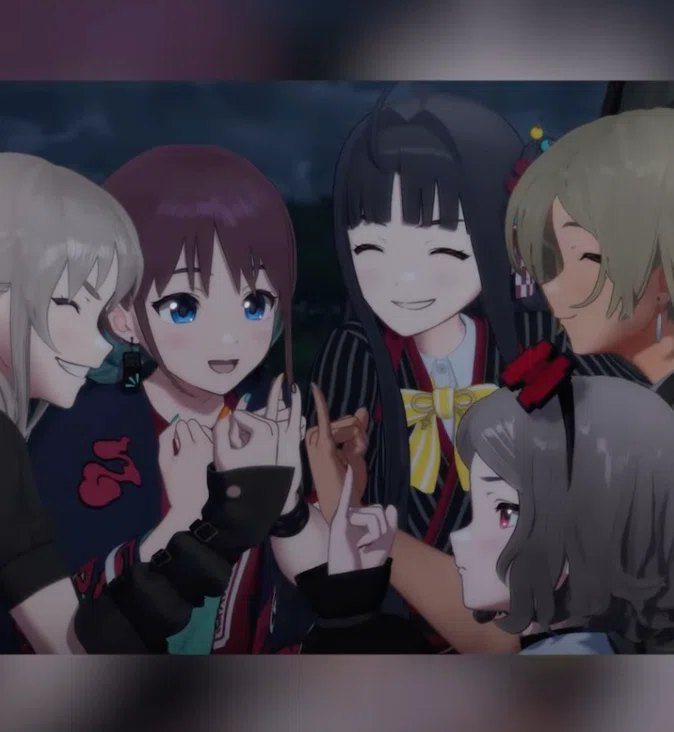
Togenashi Togeari and Diamond Dust, who had been flipping each other the finger (pinky) as rival bands, see its meaning transform after their “reconciliation” with Hina. The pinky is thrust out not as a sign directed at an ‘enemy’ to be rebelled against, but rather as a ‘pact’ symbol connecting with those once perceived as enemies, replacing the middle finger.
The pinky fuck was born not as a sign directed at the “enemy,” but as a gesture of “rock as deconstruction”—finding connection with the ‘enemy’ and invalidating the very conditions that establish binary opposition.” (End of quote)
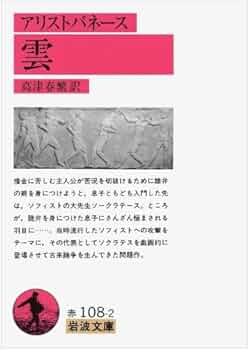
The middle finger gesture traces its origins to ancient Greece and ancient Rome.
While today it is used as an insult or provocation toward others,
or as a symbol of rebellion against established values in music genres like rock,
it was originally often employed as a parody to signify the invalidation of value.
For example, in Aristophanes’ play The Clouds,
there is a scene where the student Strepsiades uses the middle finger gesture (κατάπυγον, katapygon)
as a technique to dismiss his teacher Socrates’ instruction.
(Quote)
Just as Socrates, after much effort, gets Strepsiades to engage in thought
and is about to begin scrutinizing it,
the punchline suddenly comes: “Nothing but a drip” (penis and urine, the fuck sign).
The serious world that had been unfolding is suddenly flipped into a world of nonsense.
(End of quote)
Beyond ancient Greece and Rome, the fuck sign gradually solidified its cultural value as a symbol of power and defiance in contexts like India’s lingam worship, Japan’s Tagake Shrine, and indigenous cultures of Papua New Guinea. Similarly, it is used as a sign of defiance in the girls’ band scene.
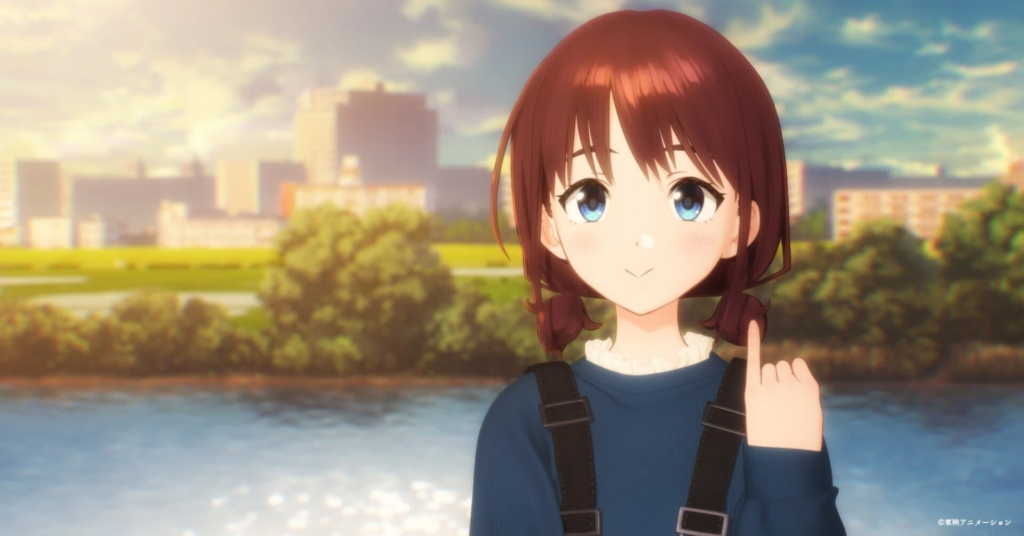
Initially, Nina mimicked Momoka (without understanding the intent) and used the fuck sign,
but at some point, its meaning changed.
Specifically, at the turning point when Nina proposed to Momoka,
“If you feel like flipping me off, just raise your pinky instead,”
the fuck sign shifted from the middle finger to the pinky.
(Quote)
Initially, it was used (as a camouflage to avoid broadcast censorship) simply as a substitute for the middle finger, to express “fuck you” to someone you dislike without them realizing it was the fuck sign. However, as mentioned above, it eventually became a gesture used by multiple characters towards each other, serving as a sign of “reconciliation” or a substitute for the pre-live huddle circle.
(End of quote, from the aforementioned Tokuda Shishi)
The pinky finger carries various connotations in Japan, but what’s crucial here is
its use in making promises (or hooking pinkies together).
The famous pinky-crossing exchange, “Finger-crossed promise, or drink the pufferfish,”
is both a pledge with penalties and a symbol of the promise itself.
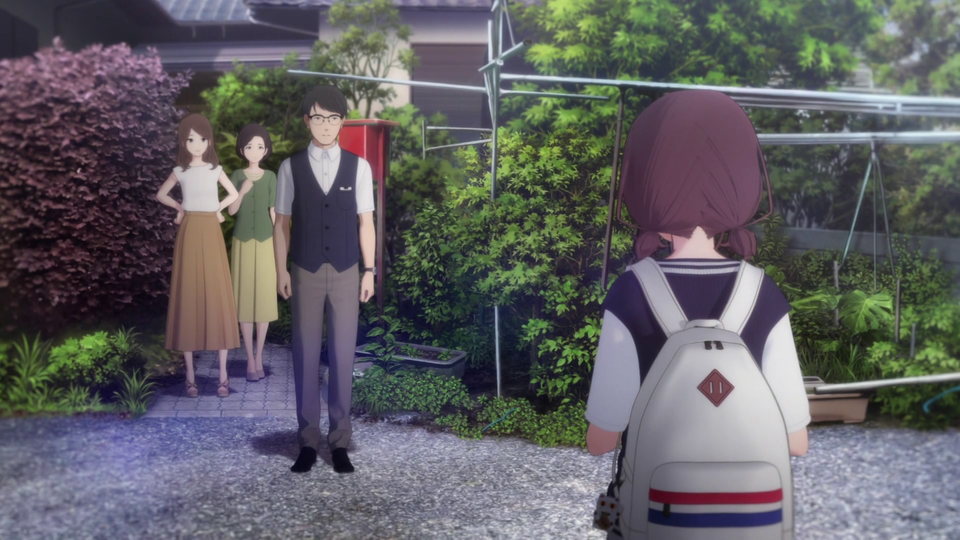
The middle finger gesture is used in various situations, but its most crucial application is likely the scene where it’s used during Nina’s reconciliation with her father, Muneo.
What was the greatest source of Nina’s anger and sorrow?
It wasn’t the bullying itself, nor the school’s response.
It was that her “father” didn’t stand by her.
Faced with Munio’s pragmatic acceptance of the school’s scheme—covering up the bullying issue while preparing recommendation letters—Nina couldn’t forgive the bullies, the school’s attitude, or her father’s response.
However, after running away, Munio regretted his actions.
He pressured the school to re-investigate and create the documents,
and even showed remorse to Nina, sympathizing with her as she listened to “Empty Box.”
What Nina then does to Munio as she leaves her family home
is the “reconciliation” of the pinky fuck sign, and the “promise” (to believe in herself for the future).
Not rebellion, but reconciliation. Not a clash of values, but the devaluation of values.
Originating in nonsense, the middle finger fuck sign evolved as a symbol of power and rebellion, sharpening its meaning to the point where broadcast codes are now erasing its existence.
Similarly, in the girls’ band scene, the pinky fuck sign—also born of nonsense, initially a symbol of power and rebellion, later evolving toward reconciliation and the devaluation of value—
created new meaning for rock as “perpetual defeat.”
This is because Hina, once a close friend who listened to Diamond Dust together,
after warning against retaliation for bullying and severing ties,
became Diamond Dust’s new vocalist.
Hina, who harbored a certain “admiration” for Nina’s earnestness and sense of justice,
remained, in fact, Nina’s steadfast confidante even now.
deliberately playing the villain to help Nina grasp music’s potential,
only to silently return the “covenant” they both cherished for music
in the final scene.
From the sharpening of shifting words, actions, representations,
as if accidental creations emerge from their evolution,
as if new possibilities sprout from enduring challenges.
What will the pinky finger’s fuck sign depict from here on?
Episode 1: “Tokyo Wasshoi”
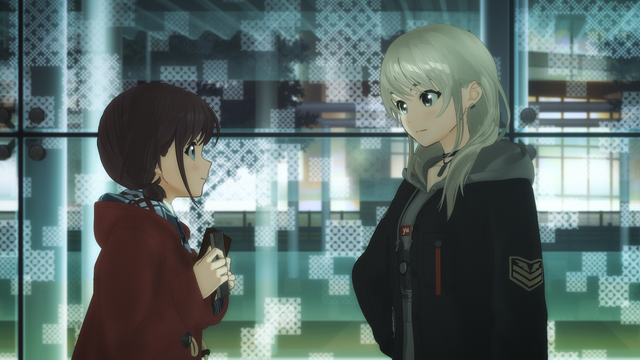
Direction: The sense of abandonment, overwhelming pressure, and rushing pace of leaving Kumamoto for Tokyo is meticulously depicted within the opening two minutes.
Evicted from the rental house, the family phone call brings the red thorns to a peak.
Contact with Momoka seems to thaw her frozen emotions.
The subsequent conversation between Nina and Momoka reveals conflict and understanding, loss and anxiety, culminating in the overwhelmingly emotional “Empty Box” through the rearrangement of music.
Screenplay: The structure gradually sharpens the initially timid Nina, intertwined with her changing attitude towards music. All elements are arranged to function both rationally and emotionally irrational.
Storyboards: The fluid transition from opening to OP contrasts with the somewhat static movement from eviction to the family phone call. The encounter with Momoka and the live performance segment flow seamlessly, truly breathtaking.
Art: The obsessive focus on CG placement makes human depictions feel slightly uncertain.
Character Design: Nina’s rabid intensity and Momoka’s resignation become apparent early on.
Sound: Subtle atmospheric layers permeate every dynamic scene.
Music: Centered around “Empty Box,” Momoka’s guitar-oriented vocals (unsuited for singers) and
Nina’s screams, anguish, and rage-filled singing create a raw, stark contrast.
Episode 2: “The Three Nocturnal Ones”
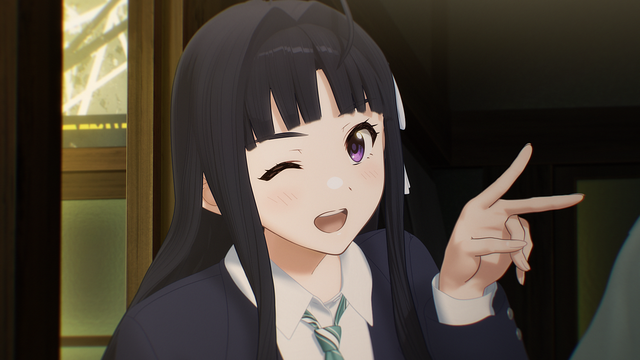
Direction: From academic background cultivation to the root of family conflict, from a pot for two to a pot for three. Setting the “empty box” adrift on the Tama River symbolizes their separation and the shift to the little finger. After encountering, clashing, and destroying each other, Subaru and Nina experience a profound sense of powerlessness. Momoka’s expansive embrace and Subaru’s comedic nature hint at future developments.
Screenplay: The structure where Nina acutely feels her past and powerlessness through separation from Momoka, reunion, encounters with Subaru/others, and conflict is masterfully depicted through unadorned dialogue and actions. Nina’s anguish as she cries out beneath the battered lighting is heartbreaking.
Storyboards: The musical segments before and after the Tama River, and Nina’s expression as she flails the lighting, feel both old and new.
Art: Momoka’s composition surrounding the toilet is precarious, and the toilet itself feels precarious.
Character Design: The reversal of Nina and Momoka’s relationship is already evident from the opening. Subaru’s voice acting feels amateurish.
Sound: While almost constantly accompanied by electric guitar, the past segments feature clinging synths that add tension and release.
Music: “Empty Box” being sucked into the Tama River symbolizes Nina’s loneliness.
Episode 3: “The Slapstick Q&A”
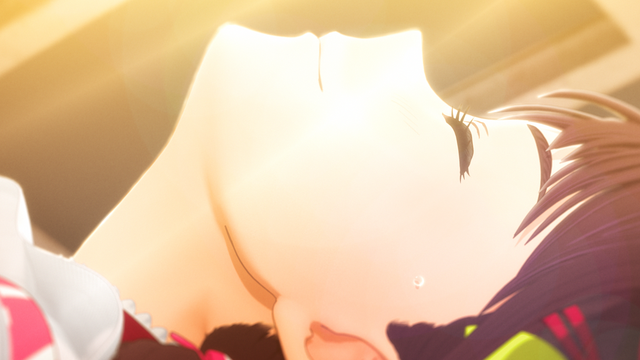
The opening skit where Nina gets absorbed in directing and composing is great.
Script: The tension and conflict between the two, sparked by Subaru’s gift, and their honest confrontation is fascinating. The exchange over the street live proposal feels painfully real. The persuasion through the karaoke experience, the consolation meal leading up to the actual street live, and Momoka egging on the still-resentful Nina with fancy costumes are all well done.
Storyboards: The angle of the camera plugging into the karaoke box’s microphone pin is excellent. In “Voiceless Fish,” Nina’s fancy-designed outfit, revealing anger and frustration, is strikingly vivid.
Art Direction: The direction for each performer synchronized with the lyrics of “Voiceless Fish,” especially the line,
“Replacements? They’re lying around everywhere,” paired with the chaotic fancy-costumed audience, intensifies the sense of powerlessness.
Character Design: Subaru’s good nature and measured aggressiveness add depth.
Sound: The electric guitar during the three characters’ clash of true feelings, and the cathartic release during vocal practice in the karaoke box are incredibly satisfying.
Music: The intro to “The Voiceless Fish” gives me goosebumps. The frustration juxtaposed against the fancy designs is deeply emotional.
Episode 4: “Gratitude (Surprise)”
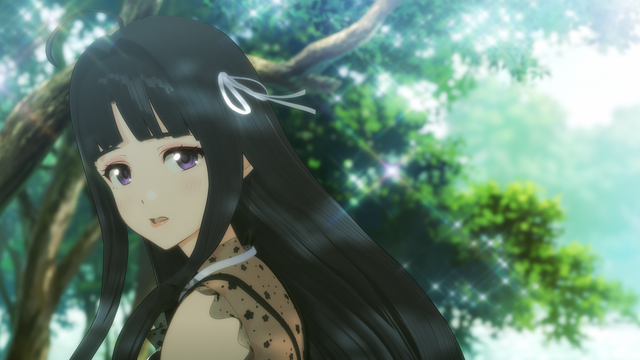
Direction: The righteous-monster Nina, who relentlessly intervenes in Subaru’s injustice and consideration, is firmly established.
Considering the screenwriter’s background, this is actually a conflict between the screenwriter’s self-portrait projected onto Subaru Awa and another persona resisting it—a full-force confrontation with the audience’s resentment.
Script: Solid groundwork is laid to dampen Subaru’s enthusiasm as Nina’s motivation surges.
Storyboards: The raw intensity of Nina’s motivation explosion after her first band performance is vividly portrayed.
Art: Shimamura Instruments, the cafe, and the school are all unaltered. The high-rise buildings with the next day’s text background are well done.
Character Design: The presence of the grandmother, reminiscent of Mitsuko Kusabue’s style, has a Kyoto-esque feel that works well. Subaru’s forced comedic moments feel painfully awkward.
Sound: The classical rock melodies in trivial scenes are pleasantly soothing.
Music: The lightness of the sketch-like score conveying Nina’s conflicting emotions toward Awa Tendou.
Episode 5: “Sing, O Voice”
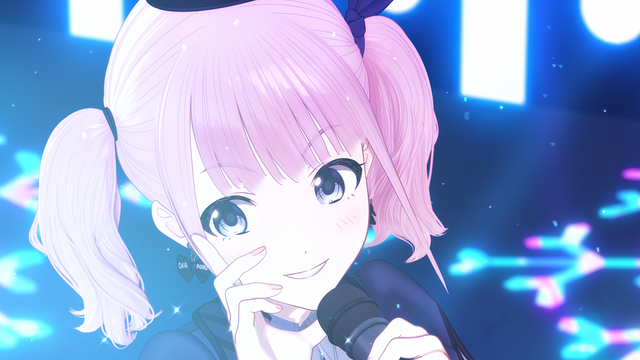
Direction: Everything converges toward hyping up the seedy live house. The heckling right before the show hits just the right note. By contrasting the world beyond the commercial break—idols and the masses—with the karaoke house—rock and the personal—the narrative sharpens and the emotional focus is drawn to “here and now.”
Screenplay: As the unease towards Diamond Dust’s new vocalist gradually builds, Nina’s anger and sorrow reach their peak through the live house’s ticket quota, the venue’s ulterior motives, the new vocalist’s true identity, and her clash with Momoka. The path leading the culmination of emotion to the live scene remains profoundly meaningful no matter how many times you watch it.
Storyboards: Diamond Dust builds their idol image from karaoke commercials to the Dome City concert, while Shin-Kawasaki (tentative name) contrasts starkly—struggling with ticket quotas from posters, screaming in a seedy live house. The sense of having made it versus the sense of never making it is vividly clear.
The meticulous detail in the bizarre background depiction during the argument over musical direction in a small izakaya ironically highlights the banality of the debate.
Art: The abnormal realism achieved through 3DCG in background art and props remains distinctly personal to the work, inviting viewers into an extension of a possible worldline (though it doesn’t truly exist). The way posters are plastered in the live house, the withered props on the stage, even the cold reactions of the izakaya’s motley crew of regulars—all shuttle viewers back and forth between a meta perspective and Nina’s emotional world.
Character Design: Nina’s rabid intensity, the sheer force with which she snaps at Momoka every time she evades her true intent. Momoka, blaming her compromised self, is juxtaposed as a resigned adult.
Sound Design: The construction of the izakaya fight makes the overly clichéd arguments feel genuinely serious.
Music: The band scene for “The Sound of Decay in the Corner of My Vision” simultaneously highlights screams and the future.
Above all, the structure is masterful: the music’s direction dissipates like mist, contrasting with the hope of the future reflected in the izakaya fight, culminating in the lyrics “What shall we paint?”
Episode 6: “Ode to the Stray”
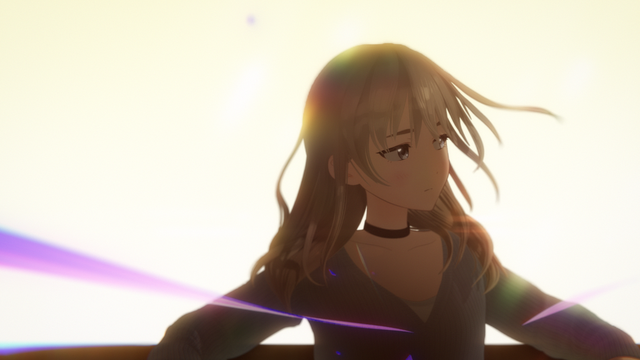
Direction: By meticulously excluding Momoka, the script structure is built to foreshadow the five members’ eventual rupture through meta-level visualization.
Specifically, Nina forcibly shifts direction—obsessed with numbers, abandoning musical ideals, and embracing idol tactics—fixating solely on defeating Diamond Dust. Her hesitation with Momoka, who cannot easily agree after clarifying her previous departure reasons, sets the stage for the split.
Script: Centered on the hesitation of Rupa and Tomo—whose bass and keyboard roles almost personify guardian and strong-willed, stubborn girl—the narrative depicts Nina’s unyielding passion for the band, Subaru’s inability to let go of resentment, and Momoka’s gradual distancing, all while depicting the process from creating a pretext for the five to gather to the actual soundcheck.
The repeated scenes of Nina and Subaru eating together (at Yoshinoya) masterfully show the distance from Momoka while creating openings for Rupa and Tomo to intervene.
Storyboards: The synergy of each part during the five members’ soundcheck visually and aurally bursts forth with rich color, expanding the worldview and leaving Momoka’s conflicting selves behind.
Art: Beyond the Yamamoto Keiki thermometer repeatedly shining in the sauna, I was impressed to discover Tomo’s Aaron chair is actually a GTRACING (same as mine and Yamaryo’s) lol.
Character Design: Rupa, who supports and sends off the even more stubborn and whiny Tomo than Nina, is both gentle and strict, portraying her as strong and beautiful. She seems like she’d be tough if you got her drunk…
Sound: The ED playing right before the end credits, during the scene depicting Momoka’s subtle state of mind, cleverly shifts the viewer’s focus.
Music: The five-member version of “The Sound of Decay in the Corner of My Vision” is finished with a dynamic energy from the bass and keyboard that feels dignified and sufficiently hints at future development.
Episode 7: “I’ll Give It a Name”
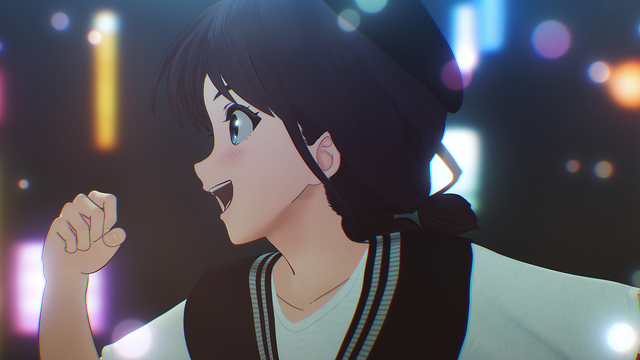
Direction: The shattering glass that seals the rift between Nina and Momoka is striking. More significantly, the focus lies on Nina’s growth and resolve—her willingness to listen to Mine-san, then drawing from that insight to shout out toward Lake Suwa, revealing a certain conviction. This is glimpsed in the fireworks display.
Script: Demonstrates Nina’s passion through band support via merchandise sales boosting attendance and revenue, while depicting environmental factors like the undecided band name and her sister’s intervention, and increasing intimacy through information about Tomo and Rupa’s circumstances.
Storyboards: The generational gap in Nana’s family home is rendered in a sketch-like style.
Art: Suwa’s worn-out live house, the shabby izakaya district, and the CG fireworks at the Suwa Lake performance feel unnervingly vivid. The entire seedy atmosphere embodies rock.
Character Design: The kitschiness of everyone being at odds is a given, but the snake is adorable.
Sound: The swaying strings in the background of the undecided band name are comical.
Music: “Nameless Everything” – Music, family, pent-up frustration toward Momoka. Emotions swirl, releasing every possible crimson thorn. Unidentifiable, unwilling to identify, unwilling to pin down. Inferiority and elation race through simultaneously.
Episode 8: “If You Should Cry”

Direction: “Don’t run away from me,” Nina confronts Momoka, her long-admired idol. Diamond Dust endures, trembling fingertips and all, to remain professional. Nina, who’s moved forward trusting her own feelings.
The depiction of Nina enveloping the cornered Momoka with her confession and deafening volume is breathtaking.
Screenplay: Momoka and Nina’s pasts intersect and collide in the present. Momoka, protecting her daily life = trapped by the past, and Nana, destroying her daily life = trying to live in the present. Momoka, who cut off her retreat and once gave up, faces Nina, who similarly cut off her retreat, forced herself to confront the present, confessed, and liberated the other.
A masterful composition that achieves sublation by colliding the core of the story with the core of the characters.
Storyboards: The unpunished Nina and the punished Momoka are contrasted as angles to the core of emotion.
Art: Dankaizaka Service Area, the back entrance of the live venue—both heighten the reality of a seedy, backstreet quarrel.
Character Design: Nina’s design, which destroys opposing values, nullifies them, and creates a future, radiates a unique presence. The birth of an unprecedented punk rock character.
Sound: Centered on the empty box, diamond dust contrasts with Nina’s position.
Episode 9: “The Crescent Moon Was Out”
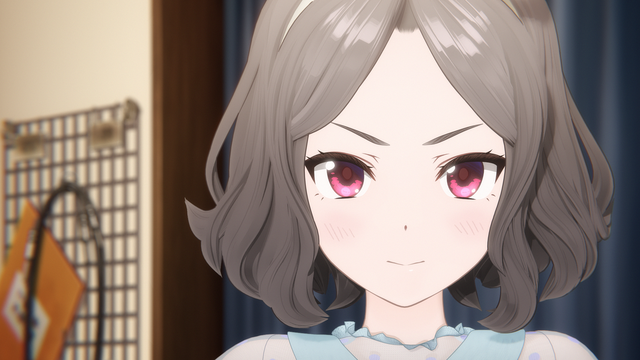
Direction: Compensates for the lack of dramatic movement with poetic imagery and sound design.
Screenplay: Triggered by an air conditioner malfunction, the clash between Tomo’s timidity and Nana’s earnestness propels him forward.
Snake predation serves as a metaphor for Satoshi. Nina’s guitar practice and references to her former band members are incorporated.
Storyboards: This episode actually establishes Lupin’s image as having excellent athletic ability. His mature adult personality contrasts sharply with his martial arts background; drinking scenes are also included.
Art Direction: The guitar scenes under the wisteria trellis and by the riverbank are contrasted. The drooping wisteria reflects his tangled emotions, while the riverbank, unobstructed, mirrors his unfiltered state of mind accompanying his words and actions.
Character Design: Forming and fleshing out Satoshi’s personality with minimal dialogue—a delicate and challenging portrayal.
Sound Design: With limited character movement, the judicious insertion of guitar strings creates atmosphere.
Episode 10: “Wander Vogel”
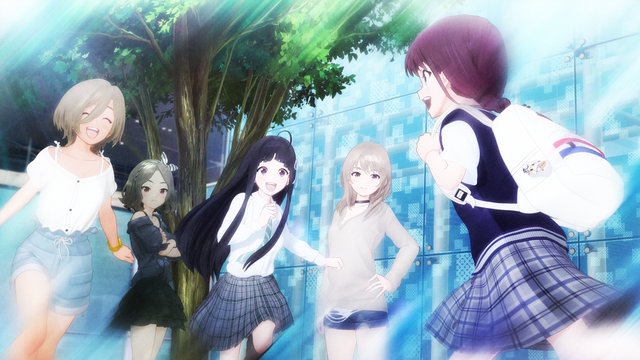
Direction: The red thorns embody the very distance between Nina and Muneo, and their confrontation and eventual calming serve as the perfect barometer.
Screenplay: I admire the skill in uncompromisingly portraying Nina’s narrow-mindedness, Muneo’s magnanimity and parental love, and the rupture and thaw between them.
Storyboards: The rupture between Muneo and Nina is emphasized through doors, piles of cigarettes, train seats, the staff room, Nina’s sister’s room, and the final embrace avoided with thoroughness, underscoring that complete reconciliation never comes.
Art: While the opening scouting scene’s landscaping is a bit off, Nina’s family home is rendered as a dense, overgrown space, evoking the scars she’s left behind. The address Aso-ku Wakaba 1-500-27 doesn’t exist; it appears to be Wakaba 1 in Higashi Ward.
Character Design: Nina’s mother’s design feels underdeveloped, but Nina’s father Muneo’s anguish, clumsiness, and parental love are well-depicted. Fundamentally, Nina’s parents hold the moral high ground throughout, yet their final gesture of standing by her side shakes viewers seeing things from Nana’s perspective.
Sound: Overall, the guitar’s comical or active background at key moments is subtly effective. Momoka’s teasing guitar is also good.
Music: Mine-san’s folk song gently yet sternly colors Nana’s departure from her family home.
Episode 11: The Center of the World
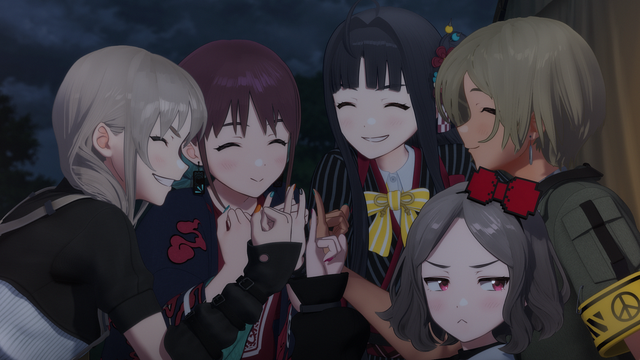
Direction: The live segments brim with tension, while the preparatory parts serve as the fuse—the balance is incredible.
Especially the live segments: no matter how many times you revisit them, you find something new. The lyrics, art direction, and performance all combine to create profoundly layered content.
Script: Beginning after the BAYCAMP festival performance, it progresses from the cramped backstage area through the individual members’ conflicts and overarching themes, via the Diamond Dust live, culminating in the overwhelming catharsis of the BAYCAMP performance. The depiction of individual human interactions captures each character’s personality and assertiveness without omission, maintaining a peculiar tension while drawing viewers into the preparation for the live’s exhilaration.
Storyboards: The sky serves as a central theme. The overcast opening, the plane taking off the day before the festival, the plane returning on the day itself, and birds (herons?) flying low during the pouring rain on the night of the main performance symbolize the timeline of self-confinement and liberation.
Art Direction: The color palette and 2D art style in Part B of the live segment, along with the clash between past and present, visually amplify the tragic grandeur and its counterforce, resulting in a masterpiece brimming with creativity.
Character Design: (※The reason for Tomo remains unexplained) Rupa, who relentlessly seeks connection; Momoka, who finds freedom in forgetting her ego; Subaru, who wants to chase after those striving while staying true to themselves; Nina, who wants to prove she isn’t wrong. The buildup through Episode 11 lends weight to the dialogue
Sound: Throughout, guitar strings play comical and kitschy melodies, yet one highlight is how Diamond Dust’s new song fully incorporates rock elements. Even Rupa’s rehearsal exchanges subtly reference Diamond Dust
Music: The melodies unleash every ounce of anger, frustration, and inferiority stemming from Nina’s father, Momoka, and Hina’s conflicts, struggles, and defeats, with every melody line assaulting the listener.
Episode 12: “The Sky Grows Dark Again”
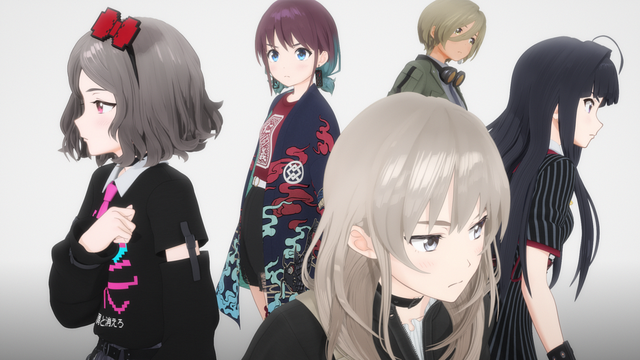
Direction: Several promotional photos featuring the final shot of the entire group at odds with each other suggest potential for the future, fitting the idol flavor better than others.
Script: True to an idol agency, it opens with promotional photos, then contract signing, the instrument shop, and the series’ first hot pot party. Diamond Dust’s challenge for a showdown and internal conflicts among members lead to songwriting struggles. Resolution comes through reconciliation: Nina’s pilgrimage/confession before a metaphysical perspective (God).
Storyboards: During the proposal and member arguments, the three factions—the realist, pessimist, and those supporting Nina/willing to fight/Rupa—are effectively juxtaposed through close-ups of their faces and eye movements.
Art Direction: The repeated instruments, especially the guitar (¥79,200), and surrounding props stand out with their uncanny realism. The full CG of the shrine visited to resolve songwriting discord gains a peculiar realism when combined with the members’ depictions.
Character Design: Signs of growth in Nina, who realizes her box garden girl nature upon discovering pumpkin hardness while preparing a pot. Rupa chugging sake from a cup is dangerous…
Sound: The piano line perfectly captures both brightness and poignancy in depicting Nina’s growth and childishness.
Episode 13: ‘Rock ‘n’ Roll Never Stops’
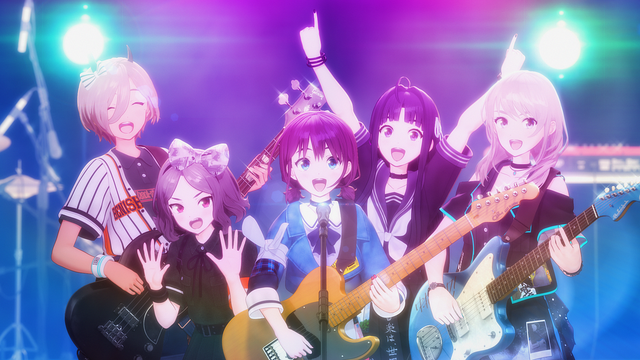
Direction: Momoka Through repeated conflicts and reconciliations with her father, Nina has steadily elevated her self-worth. Her defeat against Hina is presented as intersecting with reality (sales results), ethically proving Rock’s raison d’être and artistic stance. The brightness and loneliness of the final live performance “Destiny’s Flower” even appear literary.
Screenplay: Childish righteousness and political setbacks. Key moments are placed strategically: high school as the origin of Nina’s pent-up frustration, her severing ties with Hina, Hina’s warning, and the farewell marked by the realization of “shared feelings” with Hina. Nana’s unwavering self, her unyielding devotion to Momoka’s music, and her unconscious strength that even completes the recovery of Momoka’s setback are dazzlingly profound.
Storyboards: Overwhelmingly powerful is the depiction of Nina, who channels her tears of frustration into her feelings for Momoka and screams through her guitar to uphold her convictions, contrasting with Momoka’s acceptance of defeat after consecutive live battles following Diamond Dust. The intensity draws in not only the members present in Momoka’s room but even the viewers. This scene feels miraculously crafted by the script, storyboards, sound design, and character design working together.
Art: The backstage corridors and stage design at CLUBCITTA exude a chaotic blend of major and minor elements, directly symbolizing Togenashi Toge Ari’s journey still underway.
Character Design: A shift emerges in Tomo’s comedic timing, now tinged with warmth and affection.
Sound: The sheer power of Nina’s guitar during the daily discussions about the live shows is staggering.
Music: “Destiny’s Flower,” a song where affection for the members coexists with isolation, bright yet lonely, perfectly matches the theme of the collision and defeat between rock and reality, along with its lingering bitterness.
Addendum: 2025・10・4
Theatrical Compilation: Girls Band Cry – Youth Rhapsody
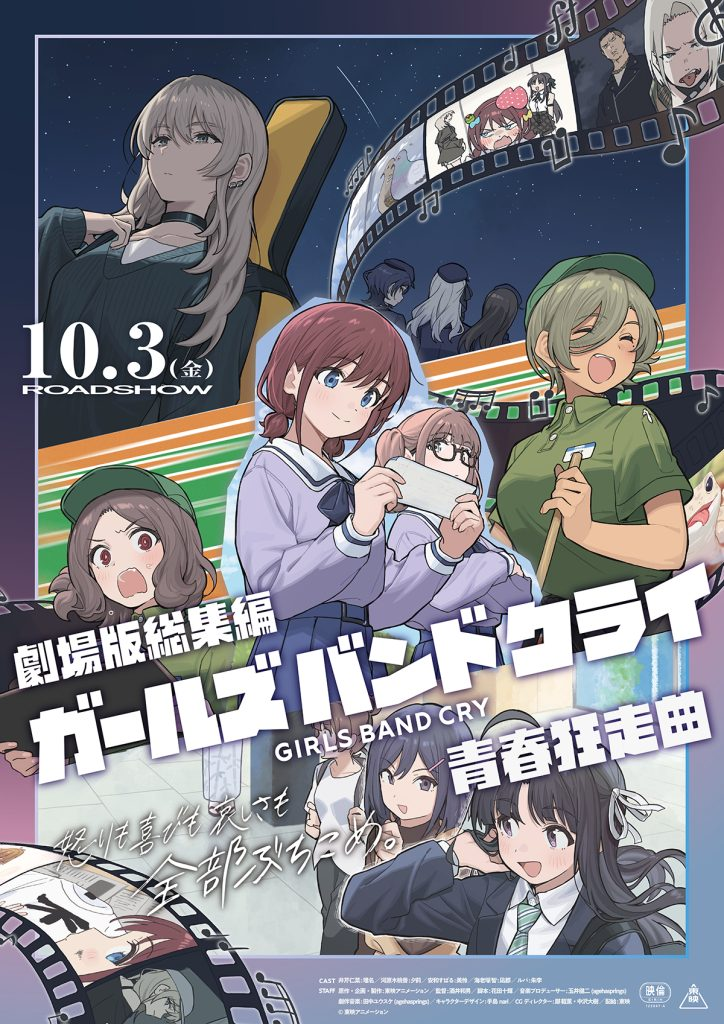
Overall: New OP and ED songs, fresh opening scenes—absolutely delightful!><
Direction: Primarily focused on Nina and Momoka’s backgrounds while maintaining Subaru and Satoshi’s presence. Gags were significantly pared down, and new storyboards were added, intensifying the impression of the two protagonists’ stage.
The OP and ED are outstanding, and the soundtrack boasts a richness unique to 5.1ch, with sound flowing between the audience seats and the stage.
Script: Cutting most of Nina’s prep school scenes, Subaru’s actor role, and the detective grandmother, while toning down the gags, actually highlights the expansion of Nana’s perspective and relationships.
The distorted interaction between the two at Suwa Rock Cafe strikes a fine balance between immediacy and restraint.
Storyboards: By adding depictions of the four characters besides Nana at the start, Hina’s back view at CLUB CITTA, the final distorted interaction between the two, and Nana agonizing over her outfit, while stripping gags like carrying Momoka down to the bare minimum, the story flows smoothly. The prickly tension as they move forward while distorted is skillfully handled.
Sound: The new OP is simply cool—worth watching multiple times for this alone.
The sound design—panning in and out with the popping of bubbles in the empty box, the anger echoing through the silent fish audience, Nina’s voice shuttling between the audience and stage at the edge of the frame—creates incredible immersion.
Addendum: 2025.11.16
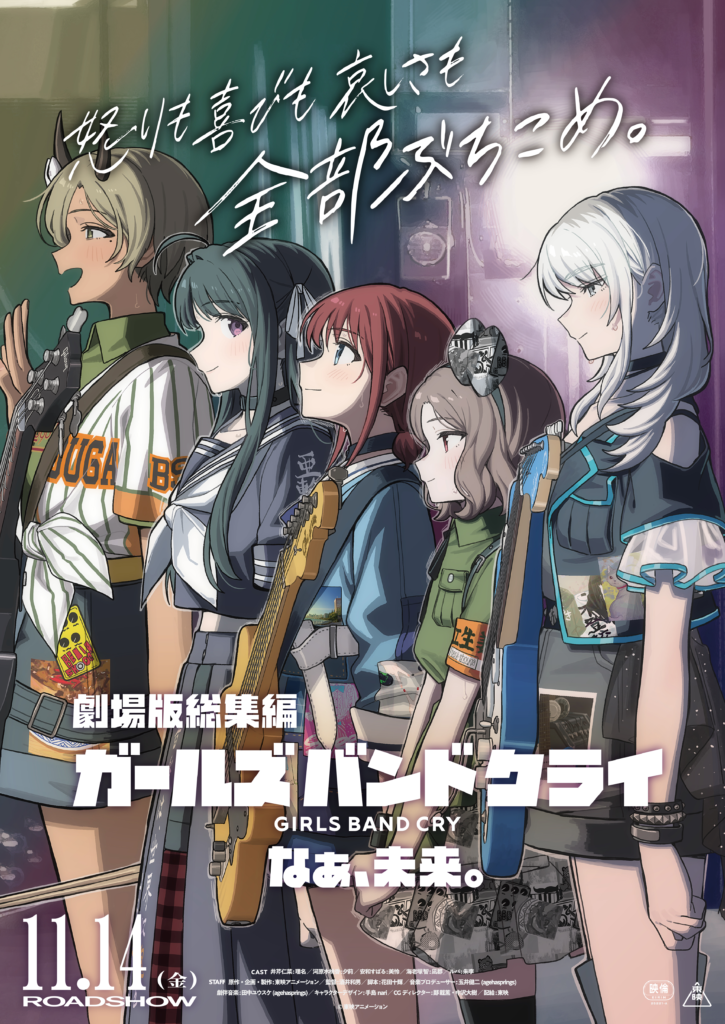
Overall: The new song “arrow,” the full version of the final live performance “Destiny’s Blossom,”
and the ED followed by the immediate announcement are crucial.
The full version of “Destiny’s Blossom” alone is worth watching repeatedly.
Direction: The full utilization of existing footage in the OP contrasts with the subsequent commotion at the live venue’s mailbox.
This sustained sense of surprise culminates in the sustained singing during the final live performance “Destiny’s Blossom.”
Storyboards:
In the post sequence after Momoka’s anguished cry, the mutual display of wounds fosters shared values,
while also hinting at a slight yuri-esque design.
Furthermore, in the encounter with Subaru’s grandmother, Obaba’s stern expression
creates a stark contrast with her gentle expression during the BAYCAMPFES live, making it a highly impactful structure.
Above all, in the singing scenes from the second verse onward during the final live performance “Destiny’s Flower,”
while grounded in what appears to be actual live performance footage,
the truly remarkable aspect is the wildly dynamic camera work—the kind only animation can achieve.
This finale alone makes the viewing worthwhile.
While noting slight disappointment with the OP’s use of existing footage,
the significance of experiencing a musical work in theaters is underscored by the simultaneous release of live-performance films like
(MrsGreen Apple, whose vocalist Nina is voiced by Rina—also Rina’s goal!), it seems to prompt a broader question: what is the value of film?
Script:
The fight at Dangozaka, the events before and after returning home from Suwa to the Momoka household,
Funny videos related to Nina’s broken air conditioner (like the doorpost incident, etc.),
The morning of the trip with her father Muneo during the Kumamoto homecoming showdown (especially near Tatsutaguchi Station),
The scene where the delinquent fan is born at BAYCAMPFES,
The conversation about the “God of Rock” at the shrine, etc. Various cuts (deletions) are made.
Instead inserted:
The shared wounds and intentions between the two after Momoka’s wailing post in “If You Should Cry,”
Subaru’s encounter with his grandmother at BAYCAMPFES,
and above all, the singing scenes from the second verse onward during the final live performance of “Destiny’s Flower” are essential viewing.
Character Design:
Scenes featuring Ebizuka Tomo and Rupa, who see little light in the first half, stand out.
Satoshi’s childish porcupine dilemma, twisted even more than Nina’s, and his empathy towards Nana and self-reflection as its counterbalance,
along with his “Baka-yarō!” immediately after biting his navel, are deeply moving.
For Rupa, her self-reflection while sending Nana off to Kumamoto—“Time with someone important is actually rare”—and her gritted-teeth monologue on the first night of BEYCAMPFES,
“The person important to me is no longer in this world,”
shake the viewer to the core.
Music:
The effective utilization of existing assets in the OP “Arrow”
stands in stark contrast to the singing scenes from the second verse onward in the final live performance of “Destiny’s Flower.”
More than the lyrics of “Destiny’s Flower,” the dynamic camera work in the live venue and the vibrant colors—fully showcasing FilMLIVE’s strengths as animation—sweep across the screen. This direction underscores the song’s importance and makes viewers feel like “witnesses to destiny.”
My daughter (a fifth grader) was also deeply moved.
References
Kiyoshi Kasai, “Bye Bye, Angel,” Sogensha Mystery Library
Girls Band Cry 1st FAN BOOK, Micro Magazine Co.
Girls Band Cry Storyboard Collection, Volumes 1 & 2
What Was ‘Girls Band Cry’: The Fuck Sign and the Inversion of the Everyday | Tokuda Shi
Thinking About “Middle Finger, Ring Finger, Little Finger” in German
“Socrates of the Clouds”
Why is giving the middle finger bad? It can get you into serious trouble overseas
[Counterargument—I Said It’s the Pinky] Reading the Critique “Who Should Nina Have Given the Middle Finger To?—On Girls Band Cry”
Girls Band Cry Alternative—Giving the Pinky to the Intellectual History of Moving to Tokyo
Why is the CG Expression in ‘Girls Band Cry’ So Approachable?
コメント